







Rice Warner actuaries have recently highlighted three key areas where self-managed superannuation funds (SMSFs) have distinct advantages over larger APRA regulated super funds.

Half of the baby-boomer generation has already retired, and the majority did so without receiving any formal financial advice. In addition, very few have built a longevity product into their retirement portfolio to prevent them outliving their retirement savings.  Most large superannuation funds still run simple account-based pensions where all risks are borne by members.

Learning from SMSFs

Well over half of all Australia’s retirement assets are held within SMSFs, as it is structured sensibly to allow retirees to manage their finances with great control whether they do so alone or in conjunction with their financial adviser.

Despite their small size compared to the behemoth industry and retail superannuation funds, SMSFs have advantages in three key areas:

  • Administration including fund and tax structure
  • Financial advice
  • Investments

Administration

The key advantage of SMSFs is that they enable pooling of family superannuation. More than 85% of these funds have been set up for couples.  A couple at retirement often have at least four underlying accounts within their SMSF, being an accumulation and a pension account for each partner.

Even when retired, an accumulation account is needed to take future contributions from any ongoing part-time work, or to hold assets exceeding the $1.6m Pension Transfer Balance cap. Moving from accumulation phase to pension phase does involve some paperwork, however the pooled investments of an SMSF don’t change so there is a relatively smooth transition.

This contrasts to APRA funds where the partners may not in the same fund, and where their accounts cannot be linked due to outdated administration platforms.  Further, shifting from a MySuper accumulation product into a retirement product can be tedious with cumbersome paperwork.

Financial Advice

As APRA funds look to provide advice to their members, they are hampered by holding only a part of a member’s financial assets, so any intra-fund advice does not capture enough information to do more than recommend moving out of accumulation into pension phase.

Some APRA funds provide comprehensive financial advice, they can struggle. It was no surprise to see QSuper withdraw from providing comprehensive financial advice recently.  The problem facing big superannuation funds is the cost of delivery of this service and the heavy compliance risks.  These costs usually exceed any revenue from the service which means they are subsidised by other members.

Even where a full pre-retirement plan is prepared for a couple, the member is simply moved into an account-based pension, but the partner is often left in their current fund’s retirement product.  One of the reasons for this is the compliance cost of comparing the partner’s fund with the member’s fund – and the embarrassment if the partners existing superannuation fund is rated better or is more cost effective.  However, leaving the members in separate funds does makes it more complex to review strategies in future years.

Holding the superannuation assets of a couple within the same fund, such as an SMSF, materially improves the ability to facilitate the delivery of better financial advice through a broader range of options available.

Investment Strategies

Most APRA funds have a single diversified (balanced) fund shaped around MySuper.

Some funds have introduced lifecycle investments and/or bucketing solutions to help members to manage sequencing risk, including sudden downturns in investment markets leading into and during retirement.   However, the absence of longevity products means that members still take on the risk of living beyond life expectancy (running out of money) as well as taking all investment market risks.

A balanced fund is ideal for those saving for retirement, but it is not optimum for retirement where people need several accounts for different purposes.  For example, this could include one account for making regular pension payments, a diversified fund to cater for the longer-term spending needs, and a separate allocation for longevity protection.

Once again, this is easier to structure for a couple with all their pension assets held in one place.  It is also easier to manage the tax situation.  It is well known that moving from accumulation to pension phase is not considered to be a CGT event, so deferred tax liabilities are released on retirement.  Some APRA funds now pay a pension transfer bonus to partly compensate their members, but it is not as efficient as an SMSF.

Many SMSFs also benefit heavily from franking credits and from company buy-backs.  Many SMSFs have a higher after-tax than pre-tax investment return.

Like APRA funds, SMSFs may generally lack longevity protection, apart from the safety net of the Age Pension for those who spend all their retirement benefits before they die.  SMSFs can offset longevity risk by incorporating annuity products into their investment strategies.


Summary

This article is an abridged version of “What APRA funds can learn from SMSFs in building a retirement solution” posted on the Rice Warner actuaries website 10 July 2020.

Disclaimer

SMSFs are not for everybody and the information contained in this article should not be construed as personal advice.

This information does not take into account any particular person’s objectives, financial situation or needs. Before acting on any information, you should consider the appropriateness of this information having regard to your personal objectives, financial situation or needs. We strongly recommend you obtain financial advice specific to your situation before making any financial investment or insurance decision.

If you have any questions in relation to this article please contact us.

The new financial year often brings new rules and new strategies for superannuation and the 2020/21 financial year is no exception. The two key changes this year are: the removal of the work test for anyone aged 66 and 67 years old who wish to make non-concessional superannuation contributions 2020-21; and an extension of spouse contributions to those aged between 70 to 75 years. Unfortunately, at this time the change in rules that will allow people aged 66 and 67 to access to the ‘bring forward’ rules have not been passed into law. We expect this to pass sometime in August 2020. Please check our blog for regular updates. The 50% reduction in the minimum pension rate for account-based pensions, will also apply for the of the 2020/21 financial year due to the COVID-19 pandemic.

Work test superannuation contributions 2020-21 to age 67

Regulations have recently changed that push the age where the work test is required to be met to age 67. This means persons currently aged 65 or 66 who don’t meet the work test will be able to make contributions after 1 July 2020 provided they are under age 67 at that date. Prior to 1 July 2020 if you’re (currently) aged between ages 65 and 74, to make contributions to superannuation you must meet the work test.  The work test requires a minimum of 40 hours in any consecutive 30 day period.  The age the work test applies has been increased to age 67 from 1 July 2020.

Ceasing work contributions

Bring-forward rule for non-concessional superannuation contributions 2020-21

Unfortunately, the law change which intended to extend the bring forward non concessional contribution measures to apply up to age 67 did not become law before 30 June 2020. We are now in a situation where the work test age has been extended to 67, meaning someone aged 65 or 66 from 1 July 2020 can made a $100,000 non-concessional contribution, but cannot use the bring forward rule. The law when passed will apply from 1 July 2020. However, it must be stressed that individuals should not assume the new laws will pass.  SMSF members will need to wait until the change becomes law before triggering the non-concessional bring-forward cap. It’s important to understand that a person’s total superannuation balance impacts the amount of non-concessional contributions that can be made to their SMSF:
Total Superannuation Balance on 30/06/2019 Non-concessional cap available Bring-forward period
Less than $1.4m $300,000 3 years
$1.4m to $1.5m $200,000 2 years
$1.5 to $1.6m $100,000 1 year only (current)
More than $1.6m $0 Not available

It’s also important to understand that the total superannuation balance is determined based on 30 June of the prior financial year, i.e. 30 June 2019 for the current SMSF end of financial year 2020.

Reduced 30/06/2020 Total Superannuation Balance Opportunities

There may be a silver lining with the impact COVID-19 has had on financial markets and SMSF portfolios during the 2020 financial year. For SMSF members where their total superannuation balance (TSB) was just over $1.6m as at 30/06/2019, with the new financial year clicking over 30 June 2020 balances can be used to determine eligibility to make non-concessional contributions. For example, if a persons TSB was $1.7m as at 30 June 2019, but dropped by say 12% to $1,496,000 as at 30 June 2020, there is now the opportunity for the individual to make non-concessional contributions again the in 2021 financial year where they weren’t previously eligible due to their TSB being above $1.6m. This means that provided the individual is under age 65, or if between ages 65 and 67 and they’ve met the work test rules, they are eligible to make non-concessional contributions. At the time of writing the change in legislation to enable people between the ages of 65 and 67 to trigger bring-forward non concessional contributions has not been passed.

Other changes to superannuation from 1 July 2020

In addition to the changes to superannuation contributions 2020-21, there are a number of other changes impacting SMSFs and superannuation from 1 July 2020:

Questions?

If you have any questions in regards to the content of this article, please contact your Quill Relationship Manager.

All Australian employers are required by law to pay the correct amount of quarterly super on or before the superannuation due dates 2020. Superannuation contribution payments are tax deductible to a business or individual provided they are received by the superannuation fund on or before 30 June 2020.

Many businesses pay super at the same time as they pay their staff salaries. Sometimes adjustments need to be made, and these should be paid by the superannuation cut-off date.


What are the superannuation due dates for payment 2020?

The deadlines for paying super remain the same each year, so the superannuation due dates for 2020 and 2021 super guarantee payments are:

Superannuation Guarantee QuarterSuperannuation Guarantee Due Dates
1 July – 30 September28 October
1 October – 31 December28 January
1 January – 31 March28 April
1 April – 30 June28 July


Due dates for the Small Business Superannuation Clearing House (SBSCH) 2020

If your business uses the Small Business Superannuation Clearing House (SBSCH), super payments need to be accepted by the SBSCH by 23 June 2020 to allow time for the employees’ super funds to receive the payments by 30 June 2020.

It is important to meet this timeframe as the timing of the payments may impact the individual tax position of employees.

For the purpose of claiming a tax deduction, superannuation payments are only considered to be paid once they have been processed and received by the employees’ super funds, not the date the SBSCH accepts the payments.

To learn more about the SBSCH visit the ATO superannuation website here: Small Business Superannuation Clearing House

Please also be aware that the ATO has issued a guidance that provided payment has been made to the SBSCH by 30 June (or the last day of any quarter) the superannuation is taken to be paid for Superannuation Guarantee purposes and the employer will not be liable for the Superannuation Guarantee Charge (SGC) for late super payments.

This only applies to SGC – for the business to claim the tax deduction, the contributions still must be received by the employees superannuation fund on or before 30 June, therefore the 23 June 2020 cut-off date applies as above.


Superannuation clearing house cut-off dates for EOFY 2020

Different superannuation clearing houses and sup have different due dates for their 30 June 2020 contributions:


Due dates for contributions paid to an SMSF

The 30th of June 2020 falls on a Tuesday this year, meaning that any contributions made directly to an SMSF via EFT transfer should occur on Monday 29th of June 2020 to ensure the contributions clear into the SMSF bank account prior to 30 June 2020.

Payments made on the 30th of June 2020 may also be received by the SMSF on 30 June, however check with your bank for the relevant processing times.

If payment of a contribution is to be made by cheque or promissory note (not recommended) then the trustee must be in receipt of the cheque (dated on or before 30 June 2020) and the cheque must be cashed (cleared and deposited) into the SMSF bank account as soon as possible upon receipt, i.e. within a few business days following 30 June.


Contribution caps for 2020

Contribution caps for the year ending 30 June 2020 are as follows:

Type of Contributions2020 CapDescription
Concessional Contributions$25,000Personal contributions (where a tax deduction is claimed).SG contributions from employment. Salary sacrifice amounts.
Non-Concessional Contributions$100,000Personal after-tax contributions where no tax deduction is claimed.Total superannuation balance must be below $1.6m as at 30 June 2019.
Non-Concessional Contributions (Bring-Forward Triggered)$300,000Available where a person is age 64 or under as at 1 July 2019.Maximum amount is impacted by total superannuation balance.

With concessional contributions, it’s essential any individuals liaise with their employer or payroll office to determine the timing of contributions. Many employers might pay contributions prior to 30 June 2020 to obtain a tax deduction for their business, even though they might not typically pay SG employer contributions under after the end of the respective financial quarter.

More information on contributions including non-concessional contributions and other super contribution strategies can be found here: Superannuation and SMSF End of Financial Year Checklist 2020


How Quill Group can help when it comes to superannuation

Quill Group are more than just accountants.

We assist business owners and individuals will all aspects of their financial life including:

  • Cloud Accounting Solutions including Single-Touch Payroll and Xero
  • Bookkeeping and Payroll Support
  • Business Performance Reporting and Advisory
  • Cashflow and Budgeting
  • Tax Planning, Tax Advice and Business Structuring
  • Superannuation Advice
  • SMSF Compliance and Advice

Article Contents

This superanuation and SMSF end of financial year checklist contains a number of key items for trustees to review and action prior to 30 June 2020. This 2020 end of financial year is slightly different due to a number of specific items related to COVID-19.

Due to the size of this article we recommend you utilise the Article Contents menu below to skip to the relevant section of interest.


SMSF End of Financial Year Document Checklist

If you are looking for a checklist for the documentation you need to gather to help us complete annual SMSF accounts for 2020, you can download a copy here: 2020 SMSF Documentation Checklist (Word.docx)


Contributions

The 30th of June 2020 falls on a Tuesday this year, meaning that any contributions made directly to an SMSF via EFT transfer should occur on Monday 29th of June 2020 at the latest to ensure the contributions clear into the SMSF bank account prior to 30 June 2020.

If payment of a contribution is to be made by cheque or promissory note (not recommended) then the trustee must be in receipt of the cheque (dated on or before 30 June 2020) and the cheque must be cashed (cleared and deposited) into the SMSF bank account as soon as possible upon receipt, i.e. within a few business days following 30 June.

Contribution Caps

Contribution caps for the year ending 30 June 2020 are as follows:

Type of Contributions2020 CapDescription
Concessional Contributions$25,000

Personal contributions (where a tax deduction is claimed).

SG contributions from employment. Salary sacrifice amounts.

Non-Concessional Contributions$100,000

Personal after-tax contributions where no tax deduction is claimed.

Total superannuation balance must be below $1.6m as at 30 June 2019.

Non-Concessional Contributions (Bring-Forward Triggered)$300,000

Available where a person is age 64 or under as at 1 July 2019.

Maximum amount is impacted by total superannuation balance.

With concessional contributions, it’s essential any SMSF members liaise with their employer or payroll office to determine the timing of contributions. Many employers might pay contributions prior to 30 June 2020 to obtain a tax deduction for their business, even though they might not typically pay SG employer contributions under after the end of the respective financial quarter.

When an individual is looking to claim a personal tax deduction for contributions made they need to ensure:

  • They have the appropriate level of personal taxable income (super contributions cannot push an individual into a negative taxable income position)
  • A s290-170 form (download PDF from the ATO) is completed the earlier of:
    • The date of the lodgement of the individual’s personal income tax return; or
    • Before 30 June of the income year of which the contribution relates to (i.e. 30 June 2021 for the 2020 financial year)

The ATO has further information on this topic: Notice of intent to claim or vary a deduction for personal super contributions

Compliance Concession for Concessional Contributions 2019

The ATO has said they will not review the timing of the acknowledged notice of intent to claim form for concessional contributions relating to the 2019 financial year, provided these individuals obtain an acknowledgement from their fund before 30 June 2020 – even though they’ve already lodged their personal income tax return.

Typically these forms need to have been lodged with the superannuation fund receiving the contributions before the lodgement of the individuals tax return. This concessional is primarily relevant for members of APRA regulated funds rather than SMSFs.

Unused Carry Forward Concessional Contributions

30 June 2020 is the first SMSF end of financial year where members can take advantage of carry forward unused concessional contributions. The ability to carry forward concessional contributions applies from 1 July 2018, with 2019-20 financial year being the first year an individual can access their unused carry forward concessional amount.

If an individual has unused concessional contributions, i.e. they did not contribute the full $25,000 in 2018-19 or 2019-20, then they can carry forward these amounts for five years on a rolling basis if provided their total superannuation balance is below $500,000 on 30 June (prior to the year you intend to access the unused amount).

For example, if total concessional contributions in the 2018-19 financial year were $10,000 and the eligibility criteria is met, the unused $15,000 is carried forward. Higher deductible personal contributions of up $40,000 ($15,000 + $25,000) can be made in the 2019-20 financial year. This is useful if a large taxable capital gain is made during the year as it will reduce a person’s taxable income and therefore their tax liability from the capital gain.

Remember:

  • Total superannuation balance must be below $500,000 on 30 June of the prior year before you utilise any carried forward amount (e.g. as at 30 June 2019 for the 2020 year); and
  • In some cases, an additional 15% tax can apply (30% total) to concessional contributions made to super where income and concessional contributions exceeds certain thresholds ($250,000 in 2019-20). A persons income could be higher than usual in the year when you sell an asset for a capital gain.

Catch up concessional contributions are an excellent SMSF end of financial year strategy.

In-Specie Contributions

An in-specie contribution is where an asset is transferred into an SMSF from a member of the fund at market value rather than a cash contribution. In-specie contributions made to SMSFs are limited to assets that are allowed to be acquired from members such as:

  • Listed securities (shares, ETFs etc)
  • Business real property (i.e. commercial property)

With the significant decline in equity markets across February and March 2020 due to COVID-19, individuals may be holding shares where it may be appropriate to trigger / crystallise a capital gain or loss by transferring them into their SMSF. Advice from a licensed financial advisers should always be sought prior to making these types of transactions.

In addition to in-specie contributions, SMSF members should be aware that the following will also be counted as contributions:

  • Paying expenses on behalf of the SMSF
  • Undertaking work to increase the value of an asset of the fund (e.g. ‘sweat equity’ on DIY property renovations)
  • Forgiving a debit the SMSF owes a member or related party
  • Paying a liability on behalf of the fund
  • Providing services to an SMSF on less than market value

1 July 2020 Changes to Work Test Age to 67

Currently, where an individual is over the age of 65 at 1 July of a financial year, they need to meet the work test of 40 hours in a consecutive 30 day period to be able to make concessional or non-concessional contributions. This applies for the current SMSF end of financial year 2020.

However, regulations have recently changed that push the age where the work test is required to be met to age 67. This means persons currently aged 65 or 66 who don’t meet the work test will be able to make contributions after 1 July 2020 provided they are under age 67 at that date.

Non-Concessional Contributions

A common SMSF end of financial year strategy is for individuals to make non-concessional (after tax contributions). As per the above contribution caps, an amount of $100,000 per anum is able to be made, or $300,000 per individual where the bring-forward is triggered.

It’s important to understand that a persons total superannuation balance impacts the amount of non-concessional contributions that can be made to their SMSF:

Total Superannuation Balance on 30/06/2019Non-concessional cap availableBring-forward period
Less than $1.4m$300,0003 years
$1.4m to $1.5m$200,0002 years
$1.5 to $1.6m$100,0001 year only (current)
More than $1.6m$0Not available

It’s important to understand that the total superannuation balance is determined based on 30 June of the prior financial year, i.e. 30 June 2019 for the current SMSF end of financial year 2020.

There are many SMSF members whose total superannuation balance has dropped significantly between 30 June 2019 and June 2020, however their reduce total superannuation (for example if it’s declined from $1.8m to $1.4m) won’t be relevant until the NEXT 2021 financial year.

Contributions Splitting

Contributions splitting enables a person to transfer or rollover 85% of their concessional contributions for a financial year from their account to their spouse’s superannuation account.

The due date for splitting contributions made during the 30 June 2019 financial year is 30 June 2020.

Spouse Contributions

If an individual’s spouse earns a low or no income, they may be able to claim a tax offset if they contribute to their spouses super fund. The offset is calculated as 18% of contributions made of up to $3,000 where the spouses income is under $37,000.

More information on the spouse super contribution offset can be found here: ATO – Spouse Contributions


Pensions

For an SMSF to claim a tax exemption on income and capital gains relating to assets that support a pension, it must meet the minimum pension requirements. Review pensions is a critical SMSF end of financial year action item for 2020.

50% Reduction in Minimum Pension for 2020

The Government has reduced the required SMSF minimum pension 2020 draw-down rates for all superannuation pensioners including SMSFs for the current financial year 2019-20 and the next financial year 2020-21.

Draw-down rates for account based pensions are normally 4% per annum for people under 65 and increase as pension recipients age. These rates have been halved for the 2020 financial year and the 2021 financial year to 2% for those people aged 64 or under and 2.5% for those between 65 and 74 years old.

The updated minimum pension drawdown rates for 2019-20 are as follows:

 % of Account Balance
 2018-192019-202020-21
Under 654%2.0%2.0%
65 – 745%2.5%2.5%
75 – 796%3.0%3.0%
80 – 847%3.5%3.5%
85 – 899%4.5%4.5%
90 – 9411%5.5%5.5%
95 +14%7.0%7.0%


New Pensions Commenced

Where a new pension has been commenced during the 2019-20 financial year, the minimum pension amounts above are calculated as a pro-rata. Prior to 30 June is an ideal time to review SMSF member balances and ensure any new pensions have been correctly documented, transfer balance account reporting has been completed and minimum pension requirements have been met.

Any new pensions commenced during the month of June do not require a minimum pension to be taken prior to 30 June of that year.

Condition of Release Triggered

Another pension related SMSF end of financial year action item for 2020 is to determine whether any members of the SMSF have triggered a condition of release.

For an individual aged between 60 and 65, a condition of release is triggered when they cease an employment arrangement, so in light of the business impacts of COVID-19, many individuals may have effectively retired early and therefore can either access their super, or where they are drawing a transition to retirement income stream convert it into an account based pension.

The ATO has an excellent web page on conditions of release.


COVID-19 Early Release Payments

As part of it’s response to COVID-19, the Government enabled eligible persons to access $10,000 as a tax free lump sum from their superannuation.

The last day for eligible persons to make an application via their MyGov ATO account is 30 June 2020 (for the 2020 financial year) and 24 September 2020 for the 2021 financial year.


SMSF 2019 Annual Return Lodgement

The Australian Tax Office has announced (22 April 2020) an automatic deferral of SMSF annual return lodgments for the 2018-19 financial year to 30 June 2020. To be clear, where an SMSF had an original lodgement date of 15 May 2020, the 2019 SMSF annual return lodgment date is deferred to 30 June.

A key SMSF end of financial year item for 2020 is to ensure the prior 2019 SMSF annual return is lodged before (preferably well before) 30 June 2020. If lodgement is late, the ATO may remove the SMSF from Superfund Lookup, meaning it will not be eligible to receive contributions, rollovers or even open new bank accounts until the lodgements have been brought up to date.


Investment Administration

Leading up to 30 June is always a great time to undertake some housekeeping of your SMSF investments.

Property Valuations

A rule of thumb with property investments held by an SMSF is that a valuation will be required at least every three years. Residential properties are typically easier to value and we can often obtain an automated valuation through our system via RP Data. Commercial properties, or properties with limited comparative sales typically would require an independent valuation from a third party.

In general SMSFs are required to value their assets at market value. Depending on the situation, a market valuation may be undertaken by a:

  • Registered valuer
  • Professional valuation service provider
  • Member of a recognised professional valuation body, or
  • A person without formal valuation qualifications but who has specific experience or knowledge in a particular area, such as a real estate agent or even the trustees themselves if they are able to follow the ATOs asset valuation approach.

For real property, the valuation may be undertaken by anyone as long it is based on objective and supportable data. A valuation undertaken by a property valuation service provider, including online services or a real estate agent is acceptable.

However, where the value of the asset represents a significant proportion of the fund’s value or where the nature of the asset indicates that the valuation is likely to be complex, the use of a qualified independent valuer should be considered. We can assist with recommending valuers who can undertake SMSF valuations

In general, real estate does not necessarily need a formal valuation each year by a licenced valuer unless there is a significant event that occurs during the year which may affect the previous valuation. A significant event could be one that directly involves the property itself, the fund on a general level such as one of the fund’s members going into pension mode, or if the asset represents a significant portion of the fund’s value.

Where as commercial property is leased to a related party business, it’s also essential that a rental appraisal is undertaken every three years to ensure the lease arrangements is conducted on an arms-length basis – i.e. market rent is being paid.

Property Lease Agreements

In addition to market valuations of properties, ensuring the lease agreements for properties, especially commercial ‘business real property’ leases are up to date and  in force is an important SMSF end of financial year item for 2020. This is especially important where an SMSF leases a commercial property to a related party tenant.

Ensure the related party tenant is adhering to the terms of the lease and has made all appropriate rent and outgoings payments (except where rent relief is applied – see below). Ensure the lease agreement has not expired and the terms of the lease are at arms length as per a rental appraisal.

Rent Relief

As a result of the economic impact of the COVID-19 pandemic and government restrictions imposed causing the widespread and substantial revenue reduction for many Australian businesses, many tenants are seeking rental relief from the landlords. This includes tenants both related and unrelated to the SMSF.

Providing rent relief to tenants is a complex area, and specialist guidance should be sought.

Private Company and Unit Trust Valuations

A key focus area with the ATO, and therefore all independent SMSF auditors over recent years has been the valuation of unlisted assets including private company and unit trust investments. All SMSF assets must be valued at market value in the financial accounts of the fund, however as there is typically no active market for these assets (compared to listed shares) obtaining accurate valuations is more difficult.

The method of valuing the private company shares or units in a private unit trust will vary depending on the exact nature of the investment – for example a unit trust holding real estate would base the valuation of the issued units on the underlying property, whereas shares in a private company operating a business could look at recent arms-length share sales / trades between shareholders or the valuation of the underlying business.

At the end of the financial year if an SMSF has these private / unlisted assets the relevant company or trust should be contacted to obtain an indicative valuation or at least copies of the financial statements to enable a valuation to be completed. If a valuation is not able to be determined, the independent auditors would likely need to qualify the audit report of the SMSF.

Valuation of Precious Metals, Artwork and Crypto-Currency

Similar to private / unlisted investments, SMSF trustees need to provide evidence of the ownership and valuation of non-standard assets such as precious metals (gold, silver, platinum), artwork and collectibles and also crypto-assets including bitcoin etc.

Artwork and Collectibles

Artwork and collectibles should typically be valued every three years by a qualified valuer. Some SMSF trustees may also want to take the opportunity to simplify the administration of their SMSF by either personally buying the artwork from their SMSF at market value, or by transferring it to themselves via an in-specie lump sum payment (if they are eligible to receive a lump sum). For either of these transactions to occur an up to date valuation must be obtained beforehand.

Precious Metals: Gold and Silver Bullion

In regards to precious metals, where any physical metals are held by a third party such as Perth Mint or with a secure storage provider such as Reserve Vault, those providers should provide a holding report and sometimes also an audit report that can be relied upon by the SMSF auditor. Where a trustee of an SMSF stores the physical bullion at their residence, they need to document an inventory, which can be done via taking photos of the relevant bullion (showing serial numbers if possible) together with a 30 June newspaper to help confirm the exact physical holdings as at the end of financial year.

Cryptocurrency

Cryptocurrency reporting is improving, however it’s recommend on or soon after 30 June, SMSF trustees who hold crypto assets as part of their investment strategy download holding and valuation reports, and if necessary a screen shot to confirm the crypto holdings as at the end of the financial year. This applies to both online wallet and broker account as well as offline cold storage wallets. In addition the public keys of all SMSF coin wallets should be provided to enable the independent auditors to review transactions via the various blockchain explorers available.

Data Feeds

A useful piece of housekeeping to ease the future administration of an SMSF is to check to ensure your accountant or administrator has all data feeds for the fund’s underlying bank and investment accounts active. Ensuring everything is turned on prior to 30 June will ensure the following year administration will be more efficient.

Review Capital Gains Position

As per of the investment strategy review (see below), its recommended that SMSF trustees and their advisers determine whether there are any tax advantages of re-balancing the investment portfolio prior to 30 June. It’s important that any such transactions are not ‘wash sales’ to deliberately reduce or eliminate capital gains tax buy selling and then re-purchasing the same investments to crystalise a capital loss, but are part of a legitimate review and adjustment to the investment strategy of the fund.


Investment Strategy Review

Trustees are required to ‘regularly review’ the fund’s investment strategy. We recommend that trustees review the strategy and document the review at least annually or when the circumstances of the fund change.

Where an SMSF has entered into a borrowing arrangement to acquire an asset, trustees should seek advice to structure insurance cover either inside or outside the SMSF to assist in meeting the on-going obligations of the debt repayments. The fund’s ability to meet the on-going debt repayments can be severely jeopardised where one member of the fund dies, as the fund may have needed to utilise contributions that were being made for that member to meet the repayments. Such a scenario could result in the fund having to sell the property.


SMSF Insurance Review

SMSF trustees need to consider the need for insurance cover for the fund members when formulating and reviewing the fund’s investment strategy.

Superannuation funds are only able to offer or take out new insurance cover where the definitions are consistent with the death, terminal illness, permanent incapacity and temporary incapacity conditions of release under the Superannuation Industry Supervision Act.

It’s important that you review insurance inside your SMSF not just for compliance with the law but also effectiveness. An important issue to consider is how any insurance inside your fund should be structured; that is, from where the premiums are paid from the fund and what account any policy proceeds will be paid to inside the fund.

Correctly structuring insurance inside your fund can be complex. We recommend that SMSF Trustees seek the advice of their financial adviser to achieve the most tax effective outcomes for insurance proceeds, especially on the death of a member.


2020 End of Financial Year Summary

We’ve attempted to make this SMSF end of financial year guide as comprehensive as possible, however if you have any questions or feedback, please contact us or your adviser.

In addition, you may also find the other articles relating to the 2020 end of financial year relevant:

The Queensland Government has recently announced that property owners will be given land tax relief where their tenants have been impacted by Coronavirus.

Land tax relief Queensland measures

There are three Coronavirus land tax relief measures property owners may be eligible for:

  • land tax rebate reducing land tax liabilities by 25% for eligible properties for the 2019-20 assessment year
  • a waiver of 2% land tax foreign surcharge for foreign entities for the 2019-20 assessment year
  • a 3-month deferral of land tax liabilities for the 2020-21 assessment year.

Property owners do not need to apply for the foreign surcharge waiver or the 3-month deferral however the 25% Queensland land tax rebate must be applied for by 30 June 2020.


25% Land Tax Rebate

The land tax rebate will only apply to each property that meets the eligibility requirements and conditions.

Where there are multiple tenants for a single property, including mixed-use developments, if the eligibility requirements and conditions are met for at least one tenancy, then the whole property is eligible for the land tax rebate.

Property owners may be eligible for the land tax rebate if at least the following circumstances applies:

  1. Property owner is a landowner who leases all or part of a property to one or more tenants and all the following apply.
    • The ability of one or more tenants to pay their normal rent is affected by the coronavirus (COVID-19) pandemic.
    • The property owner will provide rent relief to the affected tenant(s) of an amount at least commensurate (in proportion) with the land tax rebate.
    • The property owner will comply with the leasing principles even if the relevant lease is not regulated.
  2. Property owner is a landowner and all the following apply.
    • All or part of the property is available for lease.
    • The ability to secure tenants has been affected by the COVID-19 pandemic.
    • Relief required to meet financial obligations.
    • The leasing principles are complied with even if the relevant lease is not regulated.

If you are eligible for the land tax rebate under both the above circumstances, it is expected you will apply the rebate paid firstly to provide rent relief to your tenants. You can then apply any remaining rebate to your own financial obligations (e.g. in relation to debt and other expenses).

Please find below the leasing principles referred to in the criteria lists above:


Relief package for landlords and tenants – leasing principles for a commercial landowner

To be eligible for land tax relief, a landowner must commit to comply with the principles set out below. These principles will also be introduced into Queensland law.

If you are a commercial landowner, the principles are as follows:

  1. You will negotiate in good faith with your tenant to seek a mutually agreeable resolution if their ability to pay is impacted by COVID-19;
  2. You will not evict your tenant if they are in financial distress and unable to meet their commitments due to the impact of COVID-19;
  3. You will not increase rent, except where rent is linked to turnover;
  4. You will not penalise a tenant who stops trading or reduces opening hours;
  5. You will not charge any interest on unpaid or deferred rent; and
  6. You will not make a claim on a bank guarantee or security deposit for non-payment of rent.

In addition to these principles, the Prime Minister announced a mandatory code of conduct for small and medium enterprise commercial tenancies on 7 April 2020.  The Palaszczuk Government will consult with stakeholders on the development of systems and implementation of the code in Queensland. Compliance with this code is not a requirement to receive land tax relief, but landowners with small and medium enterprise commercial tenancies are advised to familiarise themselves with the code. Visit www.australia.gov.au for further information.

There has not yet been a lot of guidance as to whether or how, you need to show you have passed the land tax rebate on to your tenants.  Until further guidance is provided by the OSR/Qld Government we would suggest the following:

For properties where you as landowner pay the land tax – We suggest that when providing the rent reduction to your tenants, you clearly state the rent reduction is partly due to the Queensland land tax relief package.  This should then be evidence you have passed on the rebate to your tenants by way of rent relief.

For properties where the tenant already pays the land tax – If you determine each property is eligible and you claim the land tax rebate of 25%, as your tenant pays the land tax directly, by applying for this rebate you are effectively giving them a rent reduction by reducing their outgoings to an amount equal to the land tax rebate you get.

If you meet the criteria and would like to apply for the rebate, please find below the link and information from the OSR website:

How to apply

  1. Log onto OSR Online (or create an account if you don’t already have one).

Your 2019–20 land tax assessment notice will have the details of your land holdings. (If you have not received your notice, you can find it under the Assessments tab once you log onto OSR Online).

  1. Select My Land.
  2. Select Manage details.

To receive the rebate, you must include or update your contact details (including email and telephone number) and bank details so that we can contact you if necessary and pay the rebate into your nominated bank account.

  1. Select Manage exemptions then Lodge new exemption.
  2. Select COVID-19.
  3. Complete the application by certifying your eligibility and selecting the applicable land parcel(s).
  4. Complete the declaration.

To access future assessment notices electronically through OSR Online (rather than by post), select Assessments. If you select this option, you will receive an email when an assessment is available.

If you have not yet paid your land tax assessment for 2019-20 or are paying by instalments, and are eligible for land tax relief, we will issue a reassessment and adjust your instalment payments.

Please take the time to read our other articles relating to COVID-19.

Most people are now aware that scammers are unfortunately ever present in our modern-day life and the frequent use of the internet has only served to increase this risk. We noticed an increase in this activity during the initial roll out of the NBN and other Government programs or initiatives. Covid 19 is yet another opportunity for increased scam activity including scams targeting superannuation.

ScamWatch, a division of the Australian Competition and Consumer Commission (ACCC) that helps protect Australians from scams, has recently reported an increase in scams since the Coronavirus crisis began.

The ACCC has advised that scammers are taking advantage of people financially impacted by the Coronavirus crisis by falsely selling products or services online and using fake emails or text messages to try and obtain personal data.

There are also reports of scammers offering to check if a person’s superannuation account is eligible for various benefits (such as the early release of superannuation) or claiming new schemes will lock people out of their accounts.

In 2019, Australians lost over $6 million to superannuation scams with people aged 45–54 losing the most amount of money.

Please remember, never give any personal information about your superannuation, bank accounts or other financial information to anyone who has contacted you by phone or email. You should first confirm who has contacted you and make sure they are a legitimate company or government representative. Hang up and call the organisation directly by doing an independent search for their contact details. Better still, check with your relationship manager if you have any doubts to their legitimacy.

Steps you can take

If you think you may have provided information about your superannuation account to a scammer, please contact our office immediately. You can also contact www.idcare.org, a free Government-supported service which will work with you to develop a specific response plan to your situation and support you through the process.

More information on Coronavirus scams is available on the Scamwatch website (https://www.scamwatch.gov.au).

Quill is here to support you if you have any further questions, please contact our office.


About COVID-19 scams

Scamwatch has received over a thousand coronavirus-related scam reports since the outbreak. Common scams include phishing for personal information, online shopping, and scams targeting superannuation.

If you have been scammed or have seen a scam, you can make a report on the Scamwatch website, and find more information about where to get help.

Scamwatch urges everyone to be cautious and remain alert to coronavirus-related scams. Scammers are hoping that you have let your guard down. Do not provide your personal, banking or superannuation details to strangers who have approached you.

Scammers may pretend to have a connection with you. So it’s important to stop and check, even when you are approached by what you think is a trusted organisation.

Visit the Scamwatch news webpage for general warnings and media releases on COVID-19 scams.

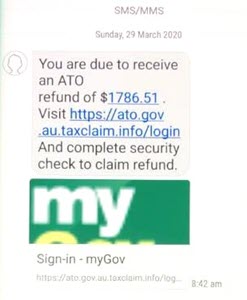
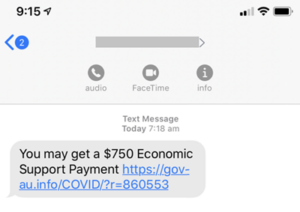
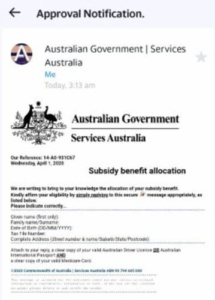
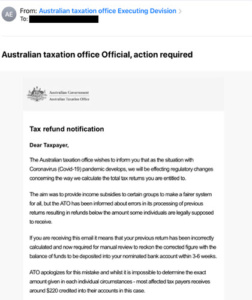
Below are some examples of what to look out for.

These are a few examples, but there are many more.  If your experience does not match any of the examples provided, it could still be a scam. If you have any doubts at all, don’t proceed.


Phishing – Government impersonation scams

Scammers are pretending to be government agencies providing information on COVID-19 through text messages and emails ‘phishing’ for your information. These contain malicious links and attachments designed to steal your personal and financial information.

In the examples below the text messages appear to come from ‘GOV’ and ‘myGov’, with a malicious link to more information on COVID-19.

If you are thinking about switching your super to cash due to recent market volatility, it’s important to understand that doing so locks-in losses and that even the savviest investors will have trouble figuring out when to re-enter the market so as to fully capture the rebound.

(more…)

Did you get a letter recently from your super fund about protecting your super?

In February 2019, changes proposed in the 2018 budget became law, and if action isn’t taken then inactive superannuation accounts could lose their insurance. The changes are due to commence from 1 July 2019, however there are steps you may need to take now to ensure the best outcome for you.


Protecting your super reforms coming into effect 1 July 2019

These reforms are designed to protect Australians’ retirement savings by ensuring their super isn’t unnecessarily eroded by fees and premiums on insurance policies they may not need.

If you are to be impacted by these changes you should have received a letter from your super fund which we encourage you not to ignore, or if you think this may impact you please contact your super fund to check.


Why is it important?

Your insurance could be cancelled

Super providers need to cancel the insurance in any super account considered inactive. An inactive account is any account that hasn’t received any contributions into the account for more than 16 months (this includes accounts that have had no contributions since 8th May 2018).

Please read the options your super provider has offered in the letter if you wish to retain your insurance. Generally, you should be able to “opt-in” via online or a form provided, which will protect your insurance cover and stop your account from being inactive, however please seek advice from your super fund or ourselves if your balance is under $6,000 as this could potentially mean your insurance is still at risk.

You could also make an urgent contribution to your super account so it is no longer inactive however you will also need to repeat this at least once every 16 months to prevent the fund from again becoming inactive. Note also the cut-off dates for opting into your insurance as they vary across super providers and some will be well before 30 June 2019.

Inactive super accounts with low balances will be closed

Many inactive accounts with a balance of less than $6,000 will be closed, and the balance transferred to the Australian Tax Office. The ATO will then use data matching to connect these super accounts with an active account of the member where possible. If there is any insurance attached to these accounts, it will also be lost.


We’re here to assist you in your financial journey

If you have any questions about completing the form, or if you would like us to review the existing cover, and do an analysis of the cover, and your insurance needs, please contact us on 07 3840 4700.

The Government introduced Treasury Laws Amendment (2018 Measures No. 4) Bill 2018 into Parliament on 28 March 2018 which affects employer superannuation contributions. This Bill introduces very serious consequences for employers who break the law by short changing their employees. The ATO will have access to new enforcement and collection provisions, including strengthened arrangements for director penalty notices. Some of the proposed amendments are to:

  1. enable the Commissioner of Taxation to issue directions to employers to pay unpaid superannuation guarantee
  2. undertake superannuation guarantee education courses
  3. to disclose more information about superannuation guarantee non-compliance to affected employees;
  4. extend Single Touch Payroll reporting to all employers;
  5. require more regular reporting by superannuation funds
  6. strengthen the commissioner’s ability to collect superannuation guarantee charge and pay as you go withholding liabilities

As an employer, specifically as a Director of a company where employer superannuation contributions and obligations have not been met, you may find yourself personally liable for unpaid superannuation. This is because Director penalties can apply to Directors of companies where the company does not meet its Superannuation Guarantee Charge (SGC) obligations.

Proposed Superannuation Guarantee Amnesty

Proposed Superannuation Guarantee Amnesty

The Government introduced Treasury Laws Amendment (2018 Superannuation Measures No. 1) Bill 2018. The Bill makes numerous amendments to superannuation and related tax laws, including to encourage the recovery of unpaid Superannuation Guarantee (SG) by introducing a temporary amnesty from late payment penalties for employers who disclose that they have underpaid SG in the past.

It is estimated that in 2014-15, around 2.85 billion in SG payments went unpaid. Of particular concern is that this estimate only relates to one income year!

The Bill complements measures proposed in Treasury Laws Amendment (2018 Measures No. 4) Bill 2018 into Parliament on 28 March that seeks to strengthen the penalty regime for SG non-compliance.

The Amnesty is proposed to last for 12 months, commencing on Thursday 24 May 2018 and ending on Thursday 23 May 2019.

The Amnesty applies only to disclosures of previously undeclared SG shortfall amounts that are made during the 12-month amnesty period and the disclosures relate to the quarters starting when the SG regime commenced and all subsequent quarters until and including the quarter starting on 1 January 2018 — that is, the period from 1 July 1992 to 31 March 2018. This is an astonishing 26 years.

The benefits of the Amnesty will not be available for SG non-compliance that occurs on or after 1 April 2018.


When is an employer eligible for the Amnesty?

To be eligible for the Amnesty, an employer must:

  1. voluntarily disclose SG shortfall amounts, relating to any period from 1 July 1992 to 31 March 2018, within the Amnesty period (24 May 2018 to 23 May 2019);
  2. disclose SG shortfall amounts that have not previously been disclosed;
  3. make the payment of the SG shortfall amount during the 12-month Amnesty period; and
  4. not have been previously informed that the ATO is examining (or that it intends to examine) the employer’s SG compliance for the relevant quarter.

An employer may still qualify for the Amnesty if it has previously made disclosures about an SG shortfall for a quarter but comes forward with information about additional amounts of SG shortfall for that quarter.


quill group accounting specialists employer superannuation


The benefits for employers who take part in the amnesty are:

  1. Administration component for SG shortfalls will be waived (currently $20 per SG statement lodged)
  2. the Part 7 penalty for failing to lodge an SG statement, equal to double the amount of the SGC, i.e. 200 per cent of the SGC payable will not apply
  3. Catch-up SG payments made between 24 May 2018 and 23 May 2019 will be tax deductible (generally, late payments of SG are not deductible for tax purposes)

The measures are aimed to incentivise employers to get up to date with their obligations and assist the Government in tackling the SG gap problem.


We are your business accounting specialists.

Get in touch with us or give our office a call on 07 5528 2000 to discuss registration in more detail. At Quill, we are passionate advocates for all of our clients and our team is focussed on providing an experience, not just great service. As the largest multi-disciplined financial services practice on the Gold Coast, we provide a high touch personalised service delivered with competence, confidence and amazing results.

As one of the country’s largest privately owned specialist Self-Managed Super Fund (SMSF) business, we are often asked about our SMSF offering and SMSF establishment, particularly:

  • How to set up a SMSF?
  • How long does it take to set up a SMSF?
  • How much does it cost to set up a SMSF?
  • What’s involved in running a SMSF?

SMSF setup can be split into five simple steps:

  1. Select the fund members and trustees
  2. Set up the trust deed
  3. Set an investment objective and an investment strategy
  4. Register with the Australian Taxation Office (ATO)
  5. Open a bank account

What are the timeframes involved in setting up a SMSF?

How long it takes to set up a SMSF can depend on a few different factors. The first three steps of setting up a SMSF can be completed in a matter of days. Step four involves the ATO and their standard processing timeframe is 28 days.  For the current financial year, the ATO is committed to finalising 93% of registrations in 20 business days.

The final step relies on your bank’s processing timeframes.


setting up a smsf


How much does it cost to set up a SMSF?

Costs of setting up a SMSF vary widely. Some SMSF businesses offer free set up in exchange for your agreement to numerous conditions.  At the other end of the spectrum, set up costs run closer to $3,000 and usually incorporates access to a professional’s time, expertise and guidance.

Contact us today if you would like more information about set up costs and our inclusions.


What is involved for a trustee in running a SMSF?

Running a SMSF needs your time, interest and know-how to keep it operating within the super laws. Breaking super laws may lead to severe penalties, regardless of whether your actions were intentional or non-intentional.

Running a SMSF typically involves keeping on top of the super laws, record keeping, accepting contributions, making payments, reviewing investments, organising fund audits, meeting tax obligations and reporting regularly to the ATO. You can engage specialists like us that help you along the way, however, the consequences of all fund decisions rests with you.


Contact us today | Quill Group are your specialists in SMSF

Now that you have the foundational knowledge of what’s involved, costs and timeframes of setting up a SMSF, get in touch with one of our specialist team members today so we can guide you through the process.

Quill Group

We’re here to help you change your life, business and family.

This field is for validation purposes and should be left unchanged.

Share This

Select your desired option below to share a direct link to this page.
Your friends or family will thank you later.